Some news and thoughts on care during pregnancy

I’ve been rather quiet for a few weeks. I have been a bit preoccupied … I’m actually pregnant with our third baby, and I’ve been contending with morning sickness, tiredness, and grumpy children!

I’m now 19 weeks and through the worst of the sickness (though it still comes in panic-inducing waves) and being pregnant again has made me reflect a bit more on my other delivery experiences.

My first son was born at 30 weeks gestation, and spent the first five weeks of his life in hospital, fed by tubes and kept alive (for a week or so at least) by machines. He did really well, but nothing can quite prepare you for that experience of having your helpless newborn isolated from you in a plastic box, wearing an arterial line, and having to leave them there every night.

I try to suppress the memories, but if I’m honest with myself, I’m terrified it’s going to happen again.

My second son was born naturally at almost full term. I had no pre-eclamsia, or other complications. But that’s no guarantee that it won’t happen again.

This time around the medical professionals seem quite unconcerned. I’m basically being left to cook. I’ll be scanned regularly from next week to make sure the baby is growing well, and like all pregnant women I’ll have my blood pressure and urine checked routinely, but today I’m feeling very uncared for. I think what has struck me most lately is the massive difference that a single medical professional can make to their patients.

I suppose what I want to do here is appeal to medical staff caring for pregnant mothers who’ve had traumatic deliveries in the past. It doesn’t matter if right now she is ok. That mother will be haunted by the terror of having her own life and the life of her fragile baby hanging in the balance. She remembers the bleeping machines, the tubes of blood, the wires, the alarms, and the fear. She remembers the smell of the hand gel on the ward, and just a whiff of it now makes her feel sick. She remembers the feeling of empty arms, and the ache of coming home to an empty cot, once full of expectation, now overflowing with anxiety.

Be gentle with her. If she is worried, acknowledge her fears instead of just dismissing them.

“I understand why you’re worried,” would be enough. With a little gentle reassurance: “But we’re going to take good care of you.”

Listen to her fears, even if you think they are unfounded. Chances are she’s been researching online whatever landed her baby in the NICU, and has come across the many exceptions to the rule that exist. Besides, even if her risk factor of it happening again is only 1%, to a mother that is 1% too high.

Don’t tell her that the slight rise in her blood pressure over the last few appointments is due to her anxiety. This is not going to help her relax in the slightest.

Don’t tell her that you have no idea why she feels breathless and nauseous because her iron levels are fine. At least suggest further investigation.

When she says that actually, she’s not felt very well through the whole pregnancy and sometimes feels as she did when she had complications, listen and acknowledge, and show some concern.

Do make eye contact and be patient. I know you are under time pressure, and probably have a list of patients the length of your arm. I know you may not have had a cup of tea for a few hours, and perhaps you had to skip lunch today. I know the pressures that rest on medical staff these days.

But this woman might have been waiting desperately for this five minutes of your time to be reassured and listened to. She might have fears that she cannot express to anyone else because they do not have the expertise to help her. Just giving her time to express those fears can help her massively.

You could be the difference between a mother feeling confident and safe, and sobbing in the car park because she feels all alone and that no one is listening to her.

Guilt-free Parenting (4) – what does it look like?

This blog entry has been written and reworked about ten times this week. I’m really struggling to expand on what I mean by ‘what is the most loving thing?’

You’d think it would be obvious, but in my personal experience, and in observing other parents first hand (and on forums and other blogs) I have come to see that our motives as parents are often veiled, even to ourselves. We can think we are loving our children, when we are not.

I think the best way I can do this is to offer examples from my own parenting experience to illustrate what I mean. What I don’t want is for anyone to feel I am judging them for their parenting decisions – I recognise that for most of us, parenting is done in survival mode, and often our decisions are born out of sheer desperation!

When I first became a parent I was determined to be the best parent I could be. This, I think, is probably what most of us aim for. No one cradles their first child and thinks, “Well, now my life has changed. I’m going to be a safely average parent.”

However, speaking personally at least, my motive included a hefty dose of pride. I didn’t see this at the time. I thought I just wanted what was best for my baby (and I did, but this was at least equally matched by pride). The pride was first in my belief in my ability to be the perfect parent (I had no idea that tiredness and the nature of children would reveal a new level of impatience and selfishness in myself); and secondly in my desire to be the perfect parent. I wanted to be admired and looked up to as a good mum. I wanted my children to be glad they had me; my husband to see what a great mother I was; and I wanted other people to ask me for advice because I had such lovely, well-behaved, securely attached children.

Oh I’m blushing now. Such honesty has come through years of falling again and again to my quick temper, my impatience, and just basic selfishness that doesn’t want to play cars or talk about lego spaceships, but wants to check facebook for the tenth time this morning (or just finish a cup of coffee without having to get up to wipe someone’s backside, for pete’s sake!)

Looking back, many of my choices were a mixture of pride and love. I did genuinely want the best for my babies, and still do, but mixed in with that is that pride at being a ‘good parent’, and also a desire for my own fulfilment.

What I mean is that I believed having children would bring me fulfilment, and make my life complete. (If you read a bit of my blog you’ll understand that a strong driving force in my life has been a desire for ‘life to the full’). What I believed would fulfil me was being the best parent ever. This led to a skewed decision making process, where I put the interests of my baby above my husband, and my own physical and mental health. That’s what a good mother does, I thought, and I was determined to be a good mother. It also led to a great deal of disillusionment as my children, far from fulfilling me, drained me of all energy and happiness and left me an exhausted, gibbering shell.

One way I thought I was being loving was because I couldn’t bear to leave my sons to cry. I had read all the blogs and books which labelled ‘crying it out’ as cruel. How could I leave my helpless baby to cry alone in the dark? All he wanted was his mummy. But I was exhausted and unable to function because of sleep-deprivation.

Now, there is a huge difference between a baby under three months of age, who is still learning to trust his caregiver and who is still disorganised in their sleep rhythm, and a baby of six months and older, who usually is getting enough nutrition during the day to no longer need milk at night, but who also now is securely attached to their parents and knows their needs will be met. There is also a huge difference between the child who is very anxious and needs a great deal of reassurance and close contact with his parents, and the baby who has just become used to a habit of falling asleep that is now disruptive to the family.

Let me explain – my two sons were bad at falling to sleep. Neither of them would willingly just lie there, close their eyes and drop off. Those cute pictures of babies who have fallen asleep in their high chairs are a mystery to me. My boys fought sleep. The only time they fell asleep without protest was in the pram or car. (And yes, we tried swaddling, dummies, patting, picking up and putting them down. In fact we could probably write a book of ideas to try to get your baby to sleep.)

With my eldest we got into the habit of rocking him to sleep. We had read the books and knew it was a rod for our backs in the making, but there was no other way he’d sleep when he was tiny. It’s time together, I tried to tell myself, bouncing around in a darkened room at 8 p.m. … though all I really wanted was to sit down on the sofa and not move for two hours. However, when he got to nine months old and woke every night at 2, 3 and 5 a.m. to be rocked back to sleep, and when he got too heavy for me to do it (we had been taking shifts) my husband put his foot down. (Did I mention that the rocking had to be done standing up? If we sat down our son would scream blue murder).

Basically, we were held hostage by a nine month old baby.

Again, looking back, my motives were mixed, but had a great deal of selfishness in them. I couldn’t bear to leave my baby to cry – the reason was partly because I feared we were refusing a need for comfort, but also a great deal of it was because I was protecting myself. I didn’t want to feel upset because he was crying.

Again, I want to stress that there is a huge difference between the crying of a four-month old baby, for example, and a nine-month old. My son was waking because he wanted to be rocked, not because he needed us. We realised this because he would quite happily settle if we rocked him in his car seat and not in our arms. It was the motion he wanted, not reassurance or physical comfort.

And his want (not need) was making us exhausted, irritable, and resentful.

Having left him to cry himself to sleep for a few nights, I realised that this had been a good decision. We all needed a good night’s sleep, our son included. He just needed to realise that it was possible to fall asleep without being rocked. His cries (which lasted 40 minutes the first night, 30 the second, and then gradually tailed off until he would moan for about ten minutes each night) were an angry protest, not distress. I should also add that my husband would go in to check him every ten minutes or so, until we realised that this was actually upsetting our boy more. He settled more quickly and with less crying if we just left him to it (listening out for that hysterical, I need you cry).

The joy of the ‘loving’ principle is that it will look differently with each family. The key is knowing your child, and knowing yourself. If my child is anxious and needy (some babies just are) then it would not be loving to leave them to cry at any age. If my child is demanding and whiny then it is loving to teach them that they are not the centre of the universe. Asking ‘what is the most loving thing’ balances the needs of each family member, and allows parents to decide for themselves which ‘wants’ of their child they are able to allow, and which they must lovingly decline.

To give another example (if you’ve read enough please just skip to my summary at the end), a child may want to sleep in their parents’ bed, but it is not always loving to give in.

I had planned on allowing our children into our bed, but once I realised this involved being repeatedly elbowed and kneed in the back, not to mention having my pillow stolen and being forced right to the edge of my bed because my son hates feeling ‘squashed’ (by which he means having any part of his body in contact with another human body) we quickly returned him to his own bed. We were all much happier that way, and occasionally, if he can lie still and enjoy being close to us, he is allowed to cuddle in bed in the mornings (if his parents are already about half awake and it is nearly time to get up).

Lastly, asking ‘what is the most loving thing’ has really helped me as my children grew older. A small baby has very basic (albeit very intense) needs – food, sleep, and security. In the long run, many of the decisions we agonise over actually make very little difference to their developing into healthy, happy adults. However, as the child develops and grows, how we relate to them and the choices we make have increasing weight in their lives. I realised recently with my two boys that their ‘love’ needs are very different. My second son, age four, is very easy for me to love. His primary need seems to be for cuddles, and as long as I am available for a quick hug and kiss at frequent intervals, he is very happy to play by himself. I love giving hugs and kisses, so our personalities meet very well.

My older son … he is another kettle of fish altogether. He has never been cuddly, pushing me away from a very young age when I tried to offer physical affection. Cuddles are asked for always on his terms, and they are usually very intense, brief, and sometimes silly. What he loves is when I play with him, talk to him, and just generally do stuff with him. I find this form of love very hard to give. I am an introvert – I love my own headspace, and my oldest son loves to invade. He will ask a thousand questions in an hour. He will tell me all about the picture he drew, the lego model he built, and while I try to be affirming and positive, some days my heart sinks. Some days, I can barely talk by the time my husband comes home, my resources have been so drained.

I am very slowly learning how to work out the most loving thing in each situation. Usually, the most loving thing is for me to set aside whatever I am engrossed in, and give my son at least half my attention. I am very bad at doing this, especially when I am tired. But, I have learned, sometimes the most loving thing is to explain to my son, kindly but firmly, that mummy is tired now and needs to stop talking, and that he must think of mummy and go and play quietly in another room (or find his brother and talk to him).

 * * * * *

A quick summary, because I being concise is not one of my strong points and you may have got lost in my ramblings:

This question, ‘what is the most loving thing?’ does three key things for us as parents.

  • It clarifies my motives. Had I asked this question when my son was waking us through the night, I would have made the same decision as a young parent to leave my son to cry, but it would have been for very different reasons. As a result, I would have had far more confidence in the decision. It would still have been hard to hear my son crying the first few nights, but I would not have been wracked by guilt for months afterwards. In fact, we probably would not have got to that point of extreme exhaustion in the first place.
  • It reduces the issues involved to one basic question – the question I asked in the first blog entry of this series – is my child loved and feeling secure today? If I can say ‘yes’, then I am making good decisions. If I am not sure, then perhaps I need to reassess and ask again, ‘what is the most loving thing’?
  • It keeps us from swinging to the extremes of parenting – either making myself the centre of all decisions and putting my child’s needs second; or putting my child at the centre of all decisions, and thus making everyone else’s needs secondary, including my own. Neither is healthy for the parents or the child. Instead, a balance is needed, where parents make sacrifices so that their child grows up loved and nurtured, but also where a child learns that the universe does not revolve around them, and that they exist to serve as well as be served.

Ultimately, going back to the whole point of this series, this question releases us from the guilt we so often feel as parents.

It frees me from the need to judge others who have decided differently from me (so I am not sitting in disapproval when my friends choose to return to work and employ a child-minder – I trust them to make loving decisions about their own family, knowing themselves and their own children).

And when, as happened recently, someone declares to my face that my choice to stay at home full time is the ‘lazy’ option, I may laugh (and then blush as I realise they are serious), and I may feel bewildered and a little angry (really? You think this is the easy option?), but ultimately I am not bothered. Because I know they are wrong. I have not made this decision out of laziness. Perhaps, as I’ve said above, my original motivations were not purely selfless or loving, but now, knowing the daily grind and exhaustion of being a full-time mum, I am still choosing it. My husband and I have looked at the options and concluded together that this is the most loving thing for our boys at the moment. And quite honestly, the longer I do it the more I realise it is the right option for me too.

My life is lived to the full as I learn to love.

Guilt-free parenting (3) The Principle!

What I wish to offer in this blog is a single principle which will simplify our parenting choices.

I have explored our history and concluded that much of our modern guilt in parenting springs from our culture not having fixed ‘rules’ about how women and children fit into this new ‘information age’. We have so many different voices telling us how to parent our children that we are confused, and can be left feeling guilty for almost any decision we make.

The problem we seem to be wrestling with most of all is what to do with the very small and most needy in our society – babies and toddlers.

Unlike previous generations, the mother who stays home is alone for most of the day – she has no servants, extended family are often remote (or working), and few neighbours who are also at home. Toddler groups are her uncertain refuge, where she can sometimes meet with judgement and unfriendliness, and which actually offer no escape from the demands of parenting. In no other society has a ‘housewife’s’ role been so limited, and a mother’s role so rigorous and isolated (if you see my previous blog you will realise that previous generations of mothers have been supported by extended family, servants, and neighbours).

It is no wonder that mothers are looking for more. Long ago, a housewife was a vital cog in the machinery of society. Now, full-time mothers are labelled as economically redundant, and their role is little valued by society. Also, mothers are left ‘holding the baby’ all alone for nine hours a day, a situation which is guaranteed to leave them exhausted and desperate for a break.

What is the answer? How can we, as a society, answer the needs of mothers and children? We need to work out new ‘rules’ for society that protect the mother’s need for validation and significance, without trampling over the needs of small children.

DSCN2350

I want to suggest a principle that we can use to make these bigger decisions, but also the smaller decisions we face as parents. Should I breastfeed or bottle feed? Should I leave my child to cry to sleep or let them into my bed? Should I return to work full or part time, or stay at home?

I want to explore this principle further tomorrow, but for now I just want to outline it. I think, if we ask one simple question, we can clarify the issues that we are wrestling with and make decisions as parents with confidence. We can withstand the aggression of people who think we have made a wrong choice.

This is the question: What is the most loving thing to do?

That’s it.

The reason I believe this question will resolve the guilt we feel as parents is that it is a secure base from which to choose and move forward. If I am confident that I have chosen what is most loving for my husband and children, and if my husband is looking out for my needs and the children then together we will be sure that the whole family’s needs are being served.

If we face criticism or judgement, we can feel secure that this is unjust; we have done what was most loving, not what was most expedient, or what was ‘best for me’. Love is never a bad motive.

I am convinced that a great deal of the guilt we feel is because, somewhere deep down, I think I have put myself first, not my children. That is what has lain behind all my guilt as a parent – I felt I should have done more or could have done more, or should have done something differently. I should have put up with the baby’s need for cuddles at 2 a.m., 3 a.m. and 4 a.m. Looking back, I realise that the most loving thing for all of us was the choice we made in the end – to leave our son to cry until he fell asleep. None of us were getting a good night’s sleep, our son included. Unfortunately, we made the decision really based on expediency and sheer desperation, and only afterwards realised that it happened to be the right choice. If we had thought it through and concluded together that the most loving thing for all of us was to have a good night’s sleep I would still have found it hard to leave my boy to cry, but I would have had peace that it was the best thing.

I had not learned to ask the right question, but since I understood its simplicity it has saved me from a great deal of anxiety.

Asking ‘what is the most loving thing’ cuts through the crap. I can’t hide behind ‘what’s best for me is best for baby’ any more. I am forced to look at the situation through objective eyes and think through the consequences for me, for my husband, and for the children. I have a standard by which to measure my choices – am I being loving here, or selfish?

(And before you panic and think I am going to tell you to be a doormat, sometimes the most loving thing is to dump the kids on your husband and go out for a coffee before you completely lose your sanity. Sometimes the most loving thing is to insist on a strict bedtime, so that you and your husband can have a glass of wine in peace, and so that you can read a book, or write a blog, or whatever. It is not loving to always give a child their way.)

Tomorrow I want to look into this principle in a bit more depth and explore it. I hope you’ll find it frees you from much of the self-doubt and guilt that plagues us today.

Guilt-free Parenting (2)

This is my second entry in a series I have bravely titled ‘guilt-free parenting’. I’m writing in response to the enormous amount of guilt I hear expressed every day by other parents, and which I have experienced myself.

* * * * *

History is a wonderful subject. It reminds us that things have not always been done the way we do them. The basic assumptions of our society have not always been accepted; in fact, our culture even a generation ago had very different beliefs about family life and society.

One of the reasons I believe we are struggling so much as parents today is because we are on the beginnings of a wave of change in our society. We are trying to work out how to live in this new ‘age of information’. We don’t know yet know how the family unit fits into it. We haven’t worked out how best to fit small children into this new structure. And so we are full of guilt because our society has not yet established ‘the rules’.

Let me explain.

02 St Fagans

For centuries we had an ‘agricultural’ society. This means that society depended on farming for survival, and our values and choices were shaped by this. So the average family owned or rented a large field, and used it to grow their food. They would produce almost all of their food and clothing themselves; if they had any extra produce they sold it to boost the family’s resources.

The family unit was vital to this society. The man was needed to work the field – the sheer physical strength required to farm all day and manage livestock meant a man was ideally suited to this job. The wife was needed to process the produce and bear children to help with the work, and her ability to multi-task and breastfeed meant she was ideally suited to this job. This all sounds very pragmatic, but I am putting it simplistically. Gravestones and historical documents demonstrate that there was a lot of love involved!

The woman’s role was not considered secondary or menial. It was vital and highly honoured. To become a ‘housewife’ and to bear children improved your status in society. If the wife did not do her job well then the man could not do his job (and vice versa), and the whole family and community suffered. When I studied history I used to be shocked at how quickly many people remarried after their husband or wife died – love clearly wasn’t as important then as it is now, I thought. What I have realised since is that actually, the roles of men and women were interdependent. A household without a wife and mother simply could not function well (and the same could be said of the husband/father).

The role of housewife in this type of society involved a great many valuable skills. She had to manage staff – even poorer households would have at least one servant; most households had several. She had charge over the family budget. She had the keys (and therefore responsibility) for the most valuable commodities of the time – spices, salt, and (after the 15th Century) sugar. She was also in charge of manufacturing, either the spinning and weaving of the cloth itself, or at least sewing clothes for her household; not to mention the daily task of feeding everybody, which involved a far greater degree of home-processing than now (e.g. sugar entered the home as a hard block and had to be processed before it could be added to cooking).

What I am trying to get at is that the role of ‘stay at home mother’ was once a highly responsible and valuable position. It was not demeaning, or restrictive to women (though other attitudes of the time may have been). In fact, it honoured her unique abilities as a woman and gave her value in society. (If you are still doubting me, read Little House on the Prairie, and ask if Ma was in a demeaning or valueless role).

In this society, children ranked very low on the scale of importance, since they had no economic value. They were dependents, but as soon as they were old enough they were gradually introduced to employment – starting around the age of five or six they would be expected to help in the home, the field, or the workshop (if their father was a tradesman). Parents would be responsible for their education. The mother would pass to her daughter skills such as how to mix medicines for common ailments, recipes, and how to manage a budget. The father would teach his son how to work the land, or pass on his trade. The family spent a great deal of time together, and there was a lot of overlap – medieval pictures, for example, show women working at the harvest. Babies were transportable – they could be carried on the back, or laid in a basket under a tree, or (apparently) tightly swaddled and hung on a peg out of the reach of rats (!), while the mother got on with her work.

Mothers were never isolated; in fact time alone was rare in this kind of society. You had at least one servant you could call on to hold the baby if you needed to get on with your work; in all likelihood your mother or mother-in-law either lived with you or very close by, as well as your extended family. And if you couldn’t afford a servant you had an entire neighbourhood community of other women and older children who would gladly help you on a difficult day.

The only people who paid for child-care were the nobility, who employed wet-nurses to breastfeed their babies so that the mother’s fertility would not be compromised, and she could bear the next heir sooner.

 * * * * *

Fast forward a few centuries to the industrial revolution. We call it a revolution. In reality, between the 17th and 18th centuries agriculture gradually took a back seat, and industry became the main place of employment, and the basis of our economy. The majority of the workforce moved from the land to the factory. This led to a change in the family dynamic.

The family stopped spending so much time together. The father left the home and his family and went out to work. Women worked in the factories too, but could not continue in this form of employment once they had a baby, so they were forced to stay home and become dependents themselves. Their task-load at home was reduced – managing a household became less valuable as clothes and food were increasingly processed and produced outside the home. Bearing children prevented the woman from working, and created more mouths to feed, while her workload had become more menial, and less valuable to society.

When the state took charge of education, children over six began to spend longer hours away from home and family as well. The family unit was being forced apart.

 * * * * *

It was no wonder that women began to feel their secondary status in this society. Unfortunately, the early feminists made a mistake. Instead of seeking to restore honour and value to a woman’s role, they reasoned that women could regain value by becoming like men. They should be allowed to work outside the home, like men, and be ‘set free’ from the demeaning and menial task of being a baby-maker and a housewife.

This is rapidly turning into an article on women’s lib instead of parenting, but this background is important. We need to recognise that it was not really society’s values that turned a woman’s role into something secondary, but rather the way society was structured after the industrial revolution. Instead of women and men both being vital cogs in the machine of society, mothers were forced into becoming dependents, while their men went out and got on with the business of making money and providing for their families.

Society’s values came to reflect this over time – by the Victorian era women were meant to be dependent. They were considered weak and incapable of responsibility.

By the 1950s an ideal had arisen of a cardboard woman who loved nothing better than to keep house and raise babies, existing effectively as a servant to her husband’s wishes.

(Except, I do not think this stereotype reflects reality, apart from in a few middle class suburbs. Both my grandmothers worked once their children were of school age and neither had a particularly servile attitude towards their husbands!)

We can see that shifts in societal structure brought about a shift in cultural values. In an agricultural age the emphasis has to be on collaboration, on the collective. We needed each other to survive and for society to function, and men and women’s respective roles were equally valuable. The industrial revolution meant that we were no longer interdependent; instead the man was responsible for supporting his family, the wife joined the children as a financial dependent, leading to a society which devalued the woman’s role.

Towards the end of the last century there was another shift. We now live in an ‘information age’. It is possible for a person to live entirely independently of others. The roles of men and women are not so clearly defined. Apart from a few jobs which require our gender-based strengths (like building and labouring, or breastfeeding) most roles can be fulfilled equally by men and women. Brute strength is not required to grow the family’s food, household management is no longer so time-consuming. We have replaced servants with machines (think washing machine, dishwasher; there are even robots which will vacuum and mop your floors – yes really! Put it on your Christmas list!) The traditional role for a woman, as housewife, is not as valuable or fulfilling as it was five hundred years ago.

 * * * * *

I hope you have found this roundup of our past interesting and thought-provoking. What I have been trying to work towards is that the current trend of guilty parenting exists partly because we still have not worked out how small children fit into this new society, where male and female roles are less obvious, where work takes place outside the home, and where the family is spending more and more time apart. We still have not worked out ‘the rules’.

Instead, we are developing values in a reactionary way. We have recognised that a woman’s role at home is limited and less productive (in an economic sense) than it has been in the past. But instead of thinking about it carefully we have reacted by simply saying, “Well then, mothers must be allowed to work like men”.

We need to consider the needs of everyone involved. What does a baby or pre-school child need? What does a mother need? What does society as a whole need? What can we do to make sure that everyone’s needs are met, and the family unit is served and not lost as our society changes?

I’m sorry if you read this hoping for an answer to your guilt as a parent. I will try to answer that in the next part of this series; but at least now you understand why you feel guilty … it is because you are struggling to meet the needs and desires of your child, yourself and your family in a ‘brave new world’. We may not have crossed oceans but we are living in a new kind of society. As far as I know, no society has lived like this before, with both parents working away from home, and children educated outside the home, and so we don’t really know how best to fit child-care into this new world. We receive conflicting advice from traditionalists, who want to maintain the old family model inherited from an agricultural era; from feminists who argue that the woman’s rights are preeminent; from politicians who want to boost the economy; from blogs and forums, our parents; and ultimately from our own instincts and desires.

I am working towards suggesting a single principle which will help you make these difficult decisions as a parent, without guilt. Stay posted!

Guilt-free Parenting

I can’t help noticing that we modern parents seem to flail in a muddy pond of guilt most of the time. We are either expressing doubt over our own decisions, or firing down others who have made the opposite decision to us.

I have been wondering lately why that is. As far as I can tell, this is a new phenomenon.

My Gran never expressed guilt for popping her babies in a pram and leaving them outside the back door while she got on with her housework. She also never expressed guilt about letting her children play in the woods near their home unsupervised for hours on end, even though my mum was once invited to go and see a stranger’s rabbit (thankfully her friend stopped her!)

My parents never expressed guilt at letting us eat non-organic food or processed sugars. Mum didn’t agonise over giving up her career to stay at home when I was born. Their decisions were confident, assured.

(They have acknowledged some guilt, like the time my mother got so frustrated with my repeatedly getting out of bed at night that she shut my bedroom door so I couldn’t get out (not locked – apparently handles were beyond me as a three-year-old) … and in the morning she couldn’t open the door because I’d fallen asleep on the floor, blocking the door, waiting pathetically for her to come back).

DSCN2350Why is our parenting experience so riddled with guilt? I’ve thought about this over the last few days, and I want to explore it in the next few blogs. Tomorrow I want to look at the history of parenting, and see if we can learn anything from our past about where we are today. (That may sound boring, but trust me for now – it’s fascinating!)

For now, I want to suggest that one of the reasons we experience so much guilt is because of the internet. We have access to an unprecedented level of advice, help and opinion on every aspect of parenting. If I choose, I can research any decision I have made as a mother and be made to feel guilty about staying home, going to work, breastfeeding, formula feeding, leaving baby to cry, co-sleeping, weaning, baby-wearing, and having a forward facing pram.

Shops guilt-trip us into buying the all-singing-all-dancing bottle warmers and food warmers (what happened to a good, old-fashioned bowl of hot water?), beeping swings and cot accessories. Blogs abound which can make us question every single decision I ever made as a mother, including the decision to become a parent at all. Forums are bursting with people ready to accuse you of everything from neglect to being a bad parent.

We also are made to feel like we are constantly falling behind those wonderful mothers who share soft-toned images of the sensory trays they made for their children, and picture of little kids making cup cakes with an adorable smudge of chocolate on one cheek (one of my ambitions is to set up
a ‘reality pinterest’ site, where parents can share pictures of their houses after they tried these idealistic projects … we were finding pinto beans in increasingly weird places for months after our one sensory tray experience.)

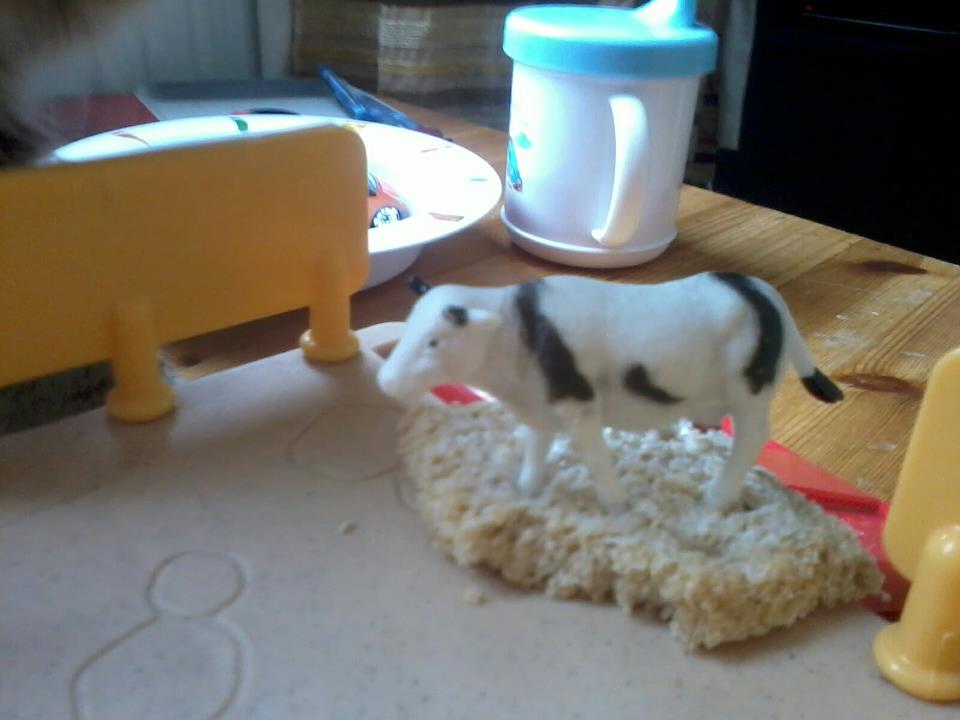
'Reality Pinterest' Image 1: how children express their creativity independently
‘Reality Pinterest’ Image 1: how children express their creativity independently

My mother never made us a sensory tray. She did bake cakes with me – once – and there is a photo to prove it. I have to wonder if any of the cakes were edible as the flour that was clearly meant to go in the bowl is all over the kitchen cupboard, the chair I am standing on, the floor, and me.

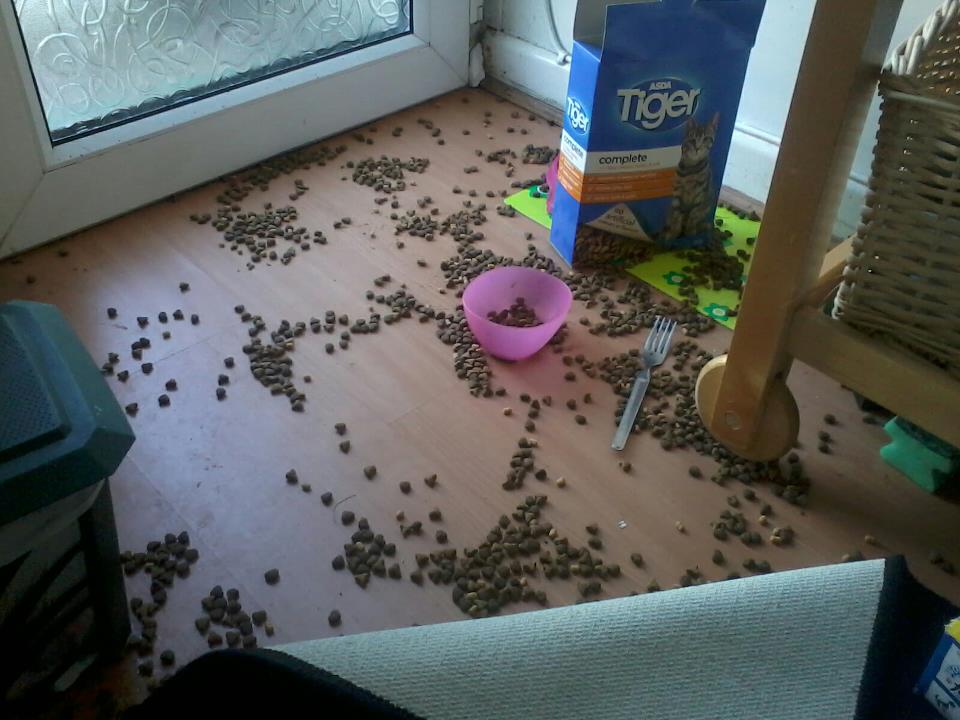
'Reality Pinterest Image 2' - A three-year old's attempt at feeding the cat.
‘Reality Pinterest Image 2’ – A three-year old’s attempt at feeding the cat.

What my mother did do was be there for me when I was happy, sad, hurt or angry. She told me when I was wrong, and (because it was the eighties and Dr Sears wasn’t around to advise her to praise me) she maintained an approving silence on the occasions I did something good. She fed me and my two sisters, tried to limit the amount of sweets and junk food we consumed, kept a supply of clean (glaringly eighties) clothes in our cupboard, chose wholesome toys for us, taught us right from wrong, and, above all, loved us. I was happy and secure.

So if you don’t bother reading the next few instalments to my ambitiously titled ‘guilt-free parenting’ series, take this with you: if your kids are currently tucked up in bed, feeling loved and secure, then you won today.

'Helping'
‘Helping’

Even if you did lose it with Johnnie when he ‘helped’ by cleaning the toilet floor and sink with a bar of soap and the toilet brush. Even if you served McDonalds for tea. Even if your kids have no idea what a sensory tray is, or sing ‘What’s on your plate?’ when you tell them it’s lunchtime, or think the right place to put still clean(ish) clothes is in a pile at the bottom of the bed … if they feel loved and secure then you deserve a mental high five. In fact, you deserve a glass of wine or a cold beer (or a cup of tea) and a sit down. You did a great job today.

When God says ‘no’

Prayer is my secret weapon. I am weak and broken, and full of fear. Prayer is how I cope. I lay my fears, my weakness and my shortcomings before my God. I receive forgiveness, and help (not often in the form I want or expect, but, still … help).

Prayer is also my source of joy. I learned through tough times that acknowledging the good things that overflow in my life (or saying ‘thank you’) brings great joy, even in pain. It puts my focus where it belongs – on the divine – instead of on me.


But sometimes I hit a wall. It happens most often when I’m praying for safety or protection (usually from whatever sickness bug is lurking in the ether) because I ask God to keep us safe, and then the finger of fear prods this nasty, insidious thought to the front of my mind:

What if God says no?

 * * * * *

That is the dilemma of every person who prays.15 View from Garden

This is the fear that turns our prayers from worship and love to manipulation and whining.

This is the doubt that turns our God into an idol, a creature of my imagination who can be persuaded and bargained with.


You remember idols. The Bible has a lot to say about them. They work like this: the idol wants (or even needs) something. I provide that thing (be it fruit, or money, or a hundred prayers, or my child) and then the idol does what I want.

It’s a business transaction. A bargain.

If I keep up my end, then I can fully expect god to do his bit and protect me.


Except God isn’t like that.

God is God. He will do what is good and right, no matter how we wheedle and plead and beg. He rules over heaven and earth and an army of angels. He even rules over demons and the forces of evil. He ‘turns the hearts of kings’, and puts governments in their place. This is the God of earthquakes, lightening and volcanos, the God of stars and solar systems … mighty forces that put the pinnacle of human power into the realm of ants and bees.

If I come to God imagining that I can offer him something he needs or wants, I do not know him at all. He isn’t even bothered by my disobedience – it makes no difference at all to his plans. All the forces of evil stand against him and he wins.

God cannot be bargained with. We offend him if we try.


So how do I pray to him? How do I get past the fear that God might say no?


Aha … (this was an ‘aha’ moment for me this week so I’m putting it in writing just for you) … aha! The fear that God might say no is the very thing that keeps me from trying to manipulate him.

Stay with me.

Look that fear full in the face. God might say ‘no’. This is not because he is petty or mean or because I haven’t offered him something big enough, but because he is great and good. Because he is God. If I was praying to a petty deity I could be afraid of his ‘no’ because I might offer him my whole life and it might not be enough.

But if I come to God as God, recognising him as the awesome Ruler of everything, if I recognise my place as the created, dependent, helpless being … if I then place myself into his hands … I am in the safest place in the universe.

Yes, that thing I fear might happen, but only because God has allowed it.


And God is God, who never willingly sends suffering into human lives (Lamentations 3:33). He remembers that we are dust. He doesn’t just remember, he knows. He became one of us. He knows what it’s like to suffer pain and sickness, tiredness and fear. He died so that you could be free of those things one day.

He is my Father. He is my Friend. So I can ask him for anything. I must remember as I do so that he is God. He may well say ‘no’ – but it is remembering this, while avoiding the impulse to try to tame the whirlwind, that is real prayer. It is laying my requests humbly before God, acknowledging on the one hand that I have no right at all to expect a favourable answer … but remembering on the other that God is good and merciful and kind and overflowing with love towards me.


“Aslan is a lion- the Lion, the great Lion.”

“Ooh” said Susan. “I’d thought he was a man. Is he-quite safe? I shall feel rather nervous about meeting a lion.”

“Safe?” said Mr Beaver. “Who said anything about safe? ‘Course he isn’t safe. But he’s good. He’s the King, I tell you.”

C. S. Lewis ‘The Lion, the Witch, and the Wardrobe’.

Looking at the thing I fear or want, looking at myself … this induces panic and the attempt to manipulate the God of heaven and earth.

Looking at God … this produces prayer.

‘I have come that they might have life, and have it to the full’

Well, you’ve read my catalogue of personal problems and you’re still with me!

Since this blog is boldly titled ‘living life to the full’ I suppose I ought to explain what I mean by it.

If you’ve read my previous posts (all three of them!) then you’ll know that my life has not exactly been a bed of roses. In addition to the poor health I described, I’ve also known personal betrayal, pain in various relationships, as well as depression.

God blessed me with a kind and loving husband, but the early years of our marriage came with illness, financial strain, and the usual adjustments that come from throwing two young and inexperienced sinners together in a small space! Add two children into the mix, along with a hefty dose of ill-health and anxiety and we find me, sitting on the side of my bed in tears, holding open the gospel of John.

I had just read the promise of Jesus, “I have come that they might have life, and have it to the full.”

I believed those words were meant for me, for anyone who called Jesus ‘Saviour’. So how come my life was anything but ‘full’? How come I sat here with a gaping emptiness in my heart? How come all the things I’d thought would make it full were actually draining me dry? A husband, a house, children … instead of joy all I felt was exhaustion and misery, and a cloying sense of walls closing about me.

“Jesus,” I sobbed. “I want that full life! I want it so much! Why hasn’t this promise been fulfilled in my life?”

* * * * *

Perhaps right now this is you. Perhaps you wake in the morning with a desperate sense of claustrophobia. Perhaps you face illness, pain and exhaustion, or perhaps you are just struggling to adjust to the mundane life of a mother.

Perhaps you are considering walking away from it all.

God takes his time in answering our questions. He does it thoroughly, building up layers of understanding until we deeply grasp his intentions. He doesn’t offer light, blithe solutions.

I had to struggle for several years before I fully understood what Jesus was promising.

* * * * *

Our society holds self-fulfilment as the ideal. We pursue comfort and personal happiness above all things. What we mean by ‘life to the full’ is the freedom to pursue our desires and feel personal satisfaction in achieving them, whatever those desires might be (a good career, a happy family life, a comfortable home …)

We find ourselves feeling depressed and anxious either when those desires are frustrated (we do not meet Mr Right, or we are unable to have children, or our career ambitions are thwarted); or when those desires do not meet up to our expectations (our partner does not fully meet our desire for companionship, or our children in fact drain us and leave us exhausted instead of giving us a reason to live, or our career fails or ends up not satisfying us as we’d hoped).

This was what happened to me. I believed that ‘life to the full’ for me was having a husband and children to care for. I believed that staying at home and raising children and keeping house would satisfy me (and there was some altruism in there also – I believed this would bless my husband and children).

I was very quickly put out of my delusion. My husband, instead of being always attentive to my needs and ready to listen to my thoughts, proved distant and detached. He was resistant to the idea of children for a while (not forever, but for longer than I wanted).

[In fairness to him, I should say that at this point he was recovering from a mysterious and painful illness picked up on a mission trip; he was out of work and depressed, and still reeling from the big changes of getting married and finding himself responsible for another human being.]

When we agreed to expand our little family, I was hit with ill health, and the children proved to be a drain on my resources, rather than the little sources of joy and fulfilment I’d anticipated. Far from fulfilling me, they emptied me, leaving me exhausted and disillusioned.

Again, I’m back to me sitting on the bed, asking Jesus what had happened to his promise.

 * * * * *

God began to answer my longing for ‘life to the full’. My friend lent me a book by a new Canadian author, ‘A Thousand Gifts’ by Ann Voskamp. I wept through the first few chapters as she described feelings of aloneness and despair. She was mother to six, and woke every morning with dread and depression. At last, another mother who felt as miserable and isolated as me! Another mother who had been let down in her longing for ‘life to the full’.

Astonishingly, this was one of the verses Ann quoted in her quest for peace and joy. She had walked the path that I was now on.

In beautiful language, Ann describes our condition as being ‘closed to grace’. We become blind to the gifts that God is showering all around us, and see only the lack, the hole, the absence.

She began to list God’s gifts to her, writing down any incidence of beauty or joy that she perceived, from rainbows in the washing up bubbles (they’re there – look next time you’re elbow deep in greasy water!) to sunshine falling on daffodils, to the laugher of her children.

She learned to count even difficult things as blessings, and I began to see that my piles of laundry and dishes were actually the result of God’s blessing. How many women in third world countries would love to have more than one set of clothes to wash; how many women would love to have more than one floor to clean; how many women around the world would give anything to be woken in the night by the cries of a child, but their baby either sleeps in a cold grave, or their womb and their arms remain empty.

Thankfulness was the key to my escape from depression. Instead of listing the things I considered burdensome and tiresome, I tried, instead, to notice the gifts. It was astonishing. The more I looked, the more I saw. I can’t say my heart sings at the thought of washing a pile of dishes now, but I have trained my heart (and it is a discipline) to look for joy. I might not enjoy washing the dishes, but I enjoy the time it gives me to think (my favourite activity!) or sing and pray; and I thank God while I do them that I have been able to feed my family, not just what they need, but delicious and healthy food.

It may sound unrealistic; and from my starting point it did. How can I thank God when I am in pain, and depressed? What is there to be thankful for?

I started with a ring of crocuses on the grass, lit by spring sunshine. With a cup of good coffee. With a hug from my son. It grew from there. The more I opened my heart and willed myself into thankfulness the more natural and obvious it became.

* * * * *

There is another aspect to the full life, however.

Through the writing of C. S. Lewis, John Piper, and Tim Keller, as well as the preaching in our church, I began to see that often we do not receive the promise of Jesus because we are looking in the wrong place. We assume that ‘life to the full’ means my own personal fulfilment. And when our desires are not met, or the things we desire prove insubstantial, we are left empty and hopeless. Or we look somewhere else. So if our marriage lets us down, we reason that we married the wrong person. He is not the right man to fulfil me; I must marry another. Or my job is not satisfying me; I must have children as well, and a second car, and a bigger house, and a holiday, new clothes … we stuff our lives with things trying to fill that empty chasm which only gets bigger as fewer and fewer things satisfy.

 * * * * *

65 Sunset Nolton Haven cliff

The book of Ecclesiastes puts it this way: God has ‘put eternity into the hearts of men’.

I think what the writer is trying to convey is that sense of emptiness we all live with. That sense that this world is not enough. Even the best of human relationships cannot possibly fully meet our every desire and need.

What is the answer?

 * * * * *

There is only one Being I know of who is infinite. Who is Love and goodness and justice and kindness, and who will love and give himself utterly for my joy.

There is eternity in our hearts, and it follows that eternity must fill it. We were made for God himself.

The thing is, Jesus will accept no rival. He is a jealous God – and this is not a negative thing. Would you be happy if your husband or wife thought nothing of admiring other men or women? Jealousy in a lover (as long as it is not possessive or selfish) is a wonderful thing. God is jealous of our hearts – he wants us to be utterly his.

And we love to fill our hands with things. I was grasping after marriage, housekeeping, children, health … anything other than Jesus to fill that gaping hole in my heart. As long as my hands were full, there was no way I could take his hand.

He was standing there, holding out his hands, waiting to offer me ‘life to the full’, himself … but I was too busy trying to hold onto the many other things I thought I could keep and be happy.

C. S. Lewis likens it to children refusing to come when called because they want to play in the mud; when their parent is offering them a day at the seaside.

Keller calls it ‘idolatry’ – worshiping lesser, created things, offering ourselves to them, when we should be offered utterly to God.

Whatever you call it, it makes us miserable.

* * * * *

“Whoever wants to save their life will lose it; but whoever loses their life for me will find it” (Matthew 16:25).

This is how we receive ‘the full life’ that Jesus promised. We cannot receive it if our hands are already full of things, full of marriage, or children, or work, or ambition, or Self.

We must give these things up, let them go, so that we can receive all of Jesus.

What does this look like?

It means I make time to pray and listen to God through his word. It means through the day I speak to him, thanking him, praising him, looking for ways to serve him. I let go of the time I want to call mine, and take God instead.

It means I ask God what he wants me to do in any situation, not deciding for myself what I should do. I let go of the controls, and take God instead.

It means I look out for the interests of others as much as my own, even preferring other people to myself – so I ask my husband what will make him happy and try to do it; I ask myself what is best for my children and do that (even if it means I have to give up my one sit-down of the afternoon in order to teach them how to share nicely); it means that I make sure I have my heart and soul in order, and get enough rest so that I am ready to serve my family again in the morning. It means, sometimes, that I ask my husband if I can go and get a coffee by myself to recharge my batteries, because I’m starting to feel irritable and stir-crazy! I let go of myself, and take God instead.

It can be painful. It feels like loss, at times. I no longer have a tight, curvy body – well, the curves are there, but in all the wrong places! But I remember that someone once gave his body for me, and that gives me courage to smile in the mirror and give thanks. I have very little time to pursue my own interests any more. I have learned to tidy regularly (though I despise the chore), because my husband feels easily stressed by clutter. Clutter doesn’t bother me, but I’ve learned I’m learning to put his interests first.

Some things are harder to give up than others. I’ve begun to see that the fulfilment of parenting is less about the joy children bring (though that is undeniable, and heart-achingly sweet), but more in the practice of daily self-sacrifice, and daily opportunity to serve the good of someone other than myself. I fail often. I frequently forget, and find myself snapping over spilled drinks and mess and broken objects; but God is so patient with me, and so forgiving.

I am still often tired, and sometimes have pain, but the more I take time to notice God’s gifts, and the less I cling to trinkets and instead seek the real treasure of loving God and being loved by him, the more joy I know, and the lighter my burdens have become.

* * * * *

‘Look for Christ and you will find him. And with him, everything else’ (C. S. Lewis).63 Sunset Nolton Haven cliff

My Emetophobia Story

This will be my last post about my personal issues for a while! I’m honestly not self-obsessed, I just think a bit of background might be useful in my future posts!

 * * * * *

This entry is about my struggle with emetophobia.

Emetophobia literally means a fear of vomiting, but it can involve a fear of nausea, other people vomiting, and even the mention or sight of words connected with vomiting.

People who do not have this will find it hard to understand. The best way I can translate it is to ask you to think of the thing you fear most. Almost all of us have some irrational fear or other, whether it is of being trapped in a lift (my husband will walk up ten flights of stairs rather than take the lift), or crashing in an aeroplane, or dogs, or birds or whatever. Most of these phobias are quite common, and people are usually quite sympathetic to a fear of closed spaces, for example. Now imagine that every day you faced the possibility of being forced into the situation you fear most, and having to endure it for several hours, possibly even days. That is what life is like for an emetophobe. Germs lurk everywhere – a trip to the library can be a source of great anxiety; all the hands that have touched the books, the tables, the chairs … how many of them were washed properly? The supermarket, the school, church, the park … each of these places and more contain hidden danger to the emetophobe.

Responses to my admission to having this phobia illustrate how misunderstood it is. “What are you afraid of?” one person asked. I couldn’t possibly put into words my answer – the physical sensation, the panic that accompanies it, the taste, the smell, the nausea, the sense of being out of control, the fear that I won’t make it to the toilet or bucket … and a shapeless, nameless fear that hangs over the entire thing.

“No one likes being sick”, is another common response. Of course not. But most people would probably not fear it so much that they would rather suffer excruciating pain than vomit. It’s not as simple as not liking it. I don’t like getting a cold, or bumping my head, or going to the dentist, but I can rationalise my dislike of these things, and manage any fear so that I can face them. I cannot rationalise the fear of vomiting. It just is a part of me.

I don’t want to overanalyse it. Sometimes people develop this fear because of a traumatic childhood experience involving a vomiting incident. But I think more often it is just part of their makeup. For myself, I am a very sensitive person. I feel things (emotionally and physically) very keenly. I have a low pain threshold, and a high sensitivity to smell, taste and sensory stimulation. This can be wonderful – I go through life in awe of the beauty around me, while most people become immune to it. But when it comes to unpleasant experiences I really struggle. And the act of vomiting, with its unpleasant stimulation of all the senses, is overwhelming, particularly for a small child who cannot minimise or rationalise the event.

By the age of ten I remember being very afraid of being sick. In university I reasoned with myself that I had to stop letting my fear be in charge. I stopped washing my hands so much, and ate things without worrying about the date.

Then in 2005, shortly after getting married, my husband and I both caught a nasty bug. I think after that I began to get more worried about vomiting.

What rocketed my emetophobia to unprecedented levels, however, was having a very premature baby. My first son was born at 30 weeks gestation, due to pre-eclampsia. He came home five weeks later in a very fragile state. He weighed only 5lbs, and we were warned by the nurses that if he caught a cold it could lead to major complications, including pneumonia and rehospitalisation. Rotavirus could cause major complications, and even kill him, as his immune system could not cope even with commonplace germs. We were told that supermarkets and other public places were dangerous for a preemie.

We took extra precautions, naturally, but for someone like me, with a predilection to anxiety over germs (and post-natal anxiety due to our traumatic birth experience) this was all I needed to allow my emetophobia full control. I had an excuse to worry now – my son could become dangerously ill.

I would wash and re-wash all his bottles, and sterilise them carefully. I washed my hands until they bled. When I finally thought he was old enough to cope with a supermarket trip I wiped the trolley down with antibacterial wipes. I wiped restaurant high chairs, and refused to let my son play with toys in a public place. I washed his hands after visiting the park, church, and friends’ houses.

I became more and more withdrawn. Going out of the house became stressful and emotionally difficult. I went to one or two toddler groups, but I was so anxious the entire time that I could barely carry on a conversation. I wouldn’t let my son eat a biscuit without putting gel on his hands. I was terrified that he would catch anything for a while, but eventually it just became stomach bugs. I couldn’t cook chicken for several months, afraid of food poisoning. I was afraid to eat food that other people had cooked. I was afraid to visit friends’ houses in case one of their children had a bug and they didn’t know it.

I knew that my fear was an overreaction. I knew that my phobia was controlling me to an unacceptable level. I was isolated, depressed, anxious and lonely.

The anxiety worsened after the birth of my second son. My health declined at this point, and I was too afraid to go to toddler groups; I would only visit friends who I felt confident were healthy. I was afraid to let my son go out with other people, or go to play centres or play groups, and so I turned down a lot of the help I could have received. I even struggled to trust my mother’s cooking, and would check that she had cooked the meat for long enough, and defrosted it correctly, before unwillingly eating.

I became badly depressed and that first year after my second son’s birth is a black hole in my memory.

I became really exhausted, trying to cope with this phobia. It was holding me back, and it had changed me into a different person. I used to love trying new things, new foods. I had wanted to travel. Now I could barely leave the house without it feeling like a huge expedition into the unknown.

You probably think I was being utterly ridiculous, but this fear is insidious. Germs are invisible. You cannot predict whether you are going to ingest them or not, or whether they will make you sick if you do. Germs can lurk anywhere. The cause of vomiting can be many things. If my kids were sick (which they were frequently, and usually not because of a bug) I would spend three days in absolute terror, bleaching everything in sight, and hardly daring to eat in case I would need to vomit myself.

(Just as a note – exposure does not work as therapy. I have been sick more often in the last seven years than I have in my entire life, and my phobia only grew worse, not better.)

 * * * * *

I prayed for release, for my own sake, for my family’s sake, and so that I could be free to serve God without fear.

Eventually I heard of a consultant in a nearby hospital who specialised in treating people with anxiety, Crohn’s disease and phobias. No one knew quite which department to put him in, so he was in physiotherapy.

I had a year of sessions with him. I learned to manage my breathing in a way that naturally calms the body down. I learned to practice mindfulness, focusing on the moment rather than imagining what might happen in the future and panicking about that.  Slowly my thought process altered, so that I no longer focussed on the possibility of getting sick. I felt calmer, less anxious, I slept better. And my Crohn’s improved, no doubt because I was no longer under such tension.

I am not fully cured – I am not sure I will ever reach the point where the possibility of vomiting does not fill me with terror. The sensation of it is bearable, but the moments before fill me with such fear and loathing that I would rather be writhing in agony. In an earthquake or an outbreak of flu I would be fearless, calm and collected. But if norovirus is about I turn to jelly.

But I do not obsess about it every day any more. I do not agonise over my sons’ safety while they are in school or nursery. I can bring myself to let them go out to a friend’s house, or just out of the house generally, without worrying overmuch.

 * * * * *

If you suffer from this condition, to whatever degree, know that you are not alone. You are not weird – this is a very common phobia. Part of the difficulty with treating this phobia is that, very often, patients do not want to get better – getting better means opening themselves to the possibility of getting sick, and this is something they fear above all things. It is not the same as fearing closed spaces; a person can reasonably expect to go through life without having to spend too much time in a confined space. A person cannot reasonably expect to avoid vomiting through their entire life. In fact, as a mother, I have had to be brave and love my children many times when everything in me was telling me to run in the other direction.

If you are a fellow emetophobe, take heart – I have endured three bouts of severe morning sickness, Crohn’s disease, and numerous stomach bugs. Most of the time, the act of vomiting was not as dreadful as I imagined it would be. A couple of times it has been, but it is over in moments, and I hardly think of those moments now. They are insignificant, compared to the joy and pleasure that I have received from my children.

 * * * * *

I sometimes wonder what God is thinking, giving an emetophobe severe morning sickness and Crohn’s disease … but I know that my phobia has made me walk closely with him when most people would have just pushed through in their own strength. My phobia, my weakness, has made me strong, because in scenarios most people would just get on with (like a bug hitting the family for example), I am forced to depend on him utterly for the strength to carry on loving my family, when all I want to do is run.

Fear makes us brave.

My Pre-Eclampsia Story

I’ve already mentioned that I had pre-eclampsia during my first pregnancy. As with Crohn’s, this is a rare and little understood illness. The factors that cause pre-eclampsia are complicated and not fully understood even by the medical community. For example, the only risk factor I had was that it was my first pregnancy (I was not ‘young’ or ‘old’, overweight, nor did I have any family history of the disease).

So this is my way of raising the profile of this disease. If you are pregnant you need to be aware of the symptoms and realise that this could happen to you. I think that was my biggest mistake.

My mother had delivered three girls naturally, going overdue with each of us. The only complicated delivery was me – I was breech and since it was 1982 my mum delivered naturally with only gas and air (respect!!).

I fully expected a normal, boring pregnancy, and anticipated going well overdue just like my mother. Dangerous diseases did not happen to people like me.

As I have outlined in a previous blog entry, I was badly mistaken. From the start of the pregnancy I had terrible diarrhoea, and when morning sickness kicked in at around 7 weeks I became increasingly miserable.

Eventually the morning sickness passed (much later than anyone said it would) and I began to feel something more like normal. In retrospect, I never really felt well at all during the pregnancy. I was determined not to be a wuss, however, and tried to carry on as normal. I was just pregnant, not ill; I was bound to feel a bit tired and sick.

Around 24 weeks my husband and I took a week’s holiday in the south of France, returning to our honeymoon location for a pre-baby treat. I felt much better that week; the nausea almost let up entirely, and I only had to cope with the diarrhoea. I remember being really tired though; we’d walk about half a mile to the beach and I’d have to rest. I struggled with the heat, but again just put it down to being pregnant. I was just one of those unfortunate women who missed out on the second trimester ‘glow’.

The irony is that I worked as a secretary for a Medical College in the department of Obstetrics and Gynaecology. One of my jobs was to type up the exam papers. I knew the symptoms of pre-eclampsia. I knew how dangerous it could be. But I had convinced myself that I was going to have a normal boring pregnancy, so I dismissed several symptoms as part of ordinary pregnancy.

This is the most dangerous aspect of pre-eclampsia, as far as I’m concerned. Each of the symptoms – swelling, nausea, headaches – can all just be attributed to a normal pregnancy.

Looking back I had several symptoms which I should not have ignored, but I kept thinking I was just being a baby and had to put up with feeling a bit unwell; it was worth it to hold my little one at last.

When I was 26 weeks some friends came to stay and we had a day out together. Towards the end of the day we had to climb a long flight of stairs. I remember my husband helping me as I gasped for air, and as waves of nausea swept over me. Our friends went ahead, unaware of how difficult I was finding it. I sat in the pub afterwards, fighting the nausea for about an hour. I never imagined it was anything other than me not coping with pregnancy.

A few days later I went shopping with my mum to buy some things for my hospital stay supposedly in a couple of months’ time. There was a sale on maternity wear and I bought some pyjamas and slippers. I remember feeling disappointed when I had to buy medium slippers when usually my dainty feet need a small. I remembered my aunty swelling up during the last weeks of her pregnancy. I must just be one of those unlucky women who swell up. Surely after the pregnancy I’d be back to my normal, dainty self. As long as I didn’t gain weight in my face I didn’t mind so much.

Alas, the next day I glanced in the mirror and my cheeks and neck looked puffy. I sighed. Never mind – it was worth it to finally be a mum. I could lose some weight after the baby was born.

The day of my twenty-eight week check was sunny. I struggled up the small hill to the hospital, and up the stairs to the outpatient department (determined not to be lazy – I was only pregnant after all). Only three months and this would all be over. I’d finally be a mum.

The midwives checked by blood pressure and urine. A small frown crossed her face.

“I’m afraid we’re going to have to send you to the MAU, love. You’ve got protein in your wee and your blood pressure’s up.”

“Oh, I just climbed two flights of stairs,” I dismissed her concerns. “Can you check it again when I’ve had a chance to sit down?”

The midwife conceded but her face was doubtful. My sister had come to the appointment with me. She was a newly qualified GP, and her expression was worried.

My BP did not go down. I spent a few hours in the MAU. They asked if I had any swelling.

“Not really,” I replied. (In my memory I’m screaming at myself – your slippers don’t fit! Your face is swollen!)

“Any disturbances in your vision?”

“I’ve been seeing some stars for a while; but I often get them anyway. I have quite low blood pressure.”

(Stop dismissing your symptoms!)

I can’t remember if they started treating me right then, but I was sent home and told to come back the next day to be checked.

Over the weekend the midwife visited me at home on the Sunday morning.

“Does this mean I won’t be likely to use the birthing pool?” I asked her anxiously. The look on her face haunts me. She was full of pity – clearly I had no grasp at all on how serious the situation was.

“No. You’ll have to be monitored closely for the delivery,” she said gently. I did not understand that, at this point, no medical professional expected me to get to full term.

She sent me into the hospital and the registrar wanted to keep me in for observation. I had no idea how much danger I and my baby were in, and begged to be sent home. I promised to return if anything changed.

After three days of being monitored daily, I had an awful Wednesday when I hardly felt the baby moving. I called the MAU at 3 a.m. and they suggested I come in to be checked for peace of mind. As I got up I was gripped with an agonising pain in my lower ribs. I’ve never felt pain like it – it felt as if I was being stabbed.

We drove to the hospital, and my husband practically had to carry me to the assessment ward. I was surrounded by the worried faces of doctors and nurses. They gave me some antacids to check whether the pain was actually indigestion; the pain subsided, but I have my doubts over whether it was the antacids which helped. I remember the midwife asking if I’d had any other trouble, and I complained of a bit of pain in my upper back. She got really cross and asked why I hadn’t said anything before. I had no idea that the pain might be significant – I thought it was down to carrying a baby and standing differently.

I didn’t leave the hospital after that. I had blood pressure checks every few hours and my urine was constantly monitored. I was given labetalol, which helps to control blood pressure, to give my baby some more time. We heard conflicting things from doctors and midwives; some said I would surely make it to full term; others said I would do well to get to 33 weeks.

It was a strange time. I don’t remember feeling afraid. I think I detached myself. I kept telling myself that the doctors were just being cautious; it wasn’t really pre-eclampsia. I was worried about the baby more than anything; I didn’t want him to be born so early.

On 21st July 2008 I woke feeling really odd. I knew something was wrong, so I tried to alert my husband (who was faithfully sleeping on a mattress on the floor of my room) but I couldn’t speak. I tried to get his attention, tried to reach the emergency button to call the nurses, but the room was fading. I could hear my husband calling my name, evidently panicked.

When I came to I was surrounded by nurses and doctors. I couldn’t remember my name or where I was. I had no idea how long I had been unconscious or what had happened. As my thoughts slowly gathered I panicked that they had taken the baby, but he was still inside me. I’d only been unconscious for two minutes. My husband said I’d been fitting.

By this point I had had so many blood tests and lines fitted that the anaesthetists were running out of veins. I had to have blood taken from my foot (painful!). I’d also damaged my neck during the fit, and could not get comfortable. I felt truly unwell at this point, and began to sink in my spirits.

It was another three days before the consultant’s felt my body could take no more. It was time to get my son out. He should have had another ten weeks inside me. There was a high chance he could suffer complications from such an early birth – brain haemorrhages are common because the preemie’s tissues are so delicate; he may need intubation, and would certainly be tube fed for the first few weeks. He may end up with severe disabilities and delayed development.

But there was no choice. If he remained inside me either he or I, or most likely both, would die, I of organ failure as my kidneys and heart failed, and he of suffocation as his supply of oxygen was cut off.

Once the decision was made it happened very quickly. I had to sign paperwork acknowledging the risks of surgery (not very reassuring as ‘death’ is listed as a possible complication!) I remember feeling very calm. My biggest worry was for my son, but the doctors were very positive. He was a good size for his dates, and didn’t seem to be suffering because of my condition (sometimes pre-eclampsia can affect the baby’s growth and development, as well as the mother’s health).

I was worried about the spinal anaesthetic, and about having an arterial line placed in my arm as I had been warned it could be painful. My father prayed with me and I was wheeled in. I hardly felt a thing as they injected my spine, and the arterial line was placed painlessly.

My sister stayed with me, whispering the 23rd Psalm in my ear as I was jerked about on the table. Within minutes she said, “he’s out”. I had been warned that he might not cry, but after a few moments a fragile wail sounded in the theatre bringing tears to my eyes. My baby had needed resuscitation but not intubation, and he was well enough after a while to be brought over to me so I could see his tiny face before he was taken upstairs in an incubator.

The stitching up took half an hour, but I don’t remember that. I drifted in and out of consciousness that whole night. Every time I opened my eyes I could see my lovely husband sitting in the corner of the room. He looked so helpless, and he had to watch while his wife’s life hung in the balance, while my arterial line failed and had to be replaced, while blood dripped from my arm onto the floor, while drugs were administered and a hoard of doctors and nurses passed in and out, keeping me alive.

Upstairs my little boy fought. He managed to keep breathing with only CPAP (puffs of oxygen into the nose) and never needed intubation.

I was given a photo of him to look at, taken by the nurses. It spent the night on my chest, and whenever I was awake enough I would look at it. At last, the following night, I was deemed well enough to be wheeled upstairs for my first proper look at my son.

It was nothing like I’d ever imagined. All the books and magazines, and even the conversations with medical staff prepare you for a magical experience, a birth in water, or on a bed, with a healthy, chubby baby placed straight on your chest.

My son was in a plastic box. I couldn’t touch him. I could barely see him – just his back, and two scrawny legs. He was drowned by the tiniest nappy size available; a big tube was fastened over his face, and wires protruded from his pathetic little arms. I learned later that one was an arterial line, and it broke my heart to think of such a tiny little body having to be infused so painfully with wires. At the time I was spared the thought of his pain. I cried anyway, overcome by guilt and sadness. This was not how it was meant to be for him or for me. I was meant to be able to cuddle him, protect him, shelter him for another ten weeks.

Instead he had to settle for plastic and wires and beeping machines.

Don’t get me wrong. I’m profoundly thankful for all the medical care he and I received. Without a doubt we would be dead in any other circumstance. My son did amazingly well – within a couple of days he was in a cot, and I could hold him for brief spells; two weeks and he was out of intensive care and into the ‘going home room’. Three weeks later we took him home. He was five weeks behind his due date. To put it in perspective, his due date was the beginning of October, but he was born at the end of July.

Pre-eclampsia is a very dangerous condition, and one of the leading causes of maternal and infant death around the world. I was looked after very well, and thankfully I and my son came out of it with no long-term health complications. But the emotional side to pre-eclampsia is poorly handled in the medical community.

I was not really offered any long-term help with the emotional trauma I had suffered. Looking back I believe I had some form of Post Traumatic Stress Disorder – I had flashbacks, an overwhelming sense of anxiety, and depression. I also had uncontrollable outbursts of anger.

Having a first baby can be very hard as it is – the sleepless nights and exhausting days take their toll on any parent. But being so physically ill meant it was many weeks before I felt able to properly care for my son.

I was also unable to breastfeed him, though I persisted in trying for three months. It could easily take an hour and a half for me to breastfeed my son, then bottle feed him, then express precious millilitres of milk into a bottle ready for the next feed. Having very little physical contact in the early weeks, as well as the physical and emotional stress of pre-eclampsia meant that my body just could not produce enough milk.

Things that stay with me are being unable to hold and touch my son in the first few days of his life. Having to stay in a post-natal ward with other mums and their babies, listening to the babies cry and wondering if my son was crying upstairs on his own. Leaving the hospital without my baby, and seeing other parents carrying their new-borns home in car-seats; being too unwell to see my boy more than once a day. Giving up on breastfeeding even though I knew it would have been far better for his tiny gut to have personalised milk instead of formula. Trying to be a ‘normal’ mum and go out with friends for a coffee – as soon as I started to feed my son I realised this would never be normal; I pulled out his bottles of medication and syringed them into his mouth; I added thickener to his milk, and had to hold him upright so he wouldn’t choke on his bottle, instead of cradling him next to me. Sobbing into the sink as I sterilised seven bottles even though I was so exhausted I could have curled up to sleep on the tiles.

These things are still painful to me six years on. I felt so alone and aching. The most common thing people said to us was, “But he’s alright now, isn’t he?” I know they meant well but it felt as though they were negating the pain we had gone through. What I really wanted was for someone to say, “I’m sorry you went through that; it must have been horrible.” But I don’t think anyone really understood.

Illness has a way of isolating the sufferer.

It helps to write these things down. It helps to acknowledge that this was a traumatic and terrible experience. It helps to realise that it still affects me, and probably will until my dying day. I will always be a mother who watched her son struggle for life, who had to let go and trust that he would be ok despite my body having failed him.

I am thankful, thankful every day that we both lived. Thankful that I was treated well and that the disease was caught. If I had missed that 28 week check I think I could well have collapsed in the next few days. I am thankful that my body recovered and that I was not left with long-term kidney or heart damage, as some women are.

I am thankful that we brought my son home, albeit in very different circumstances to the ones I’d imagined. I am thankful that he suffered no complications, but grew strong and healthy. I am thankful that formula was available to replace the milk I could not supply.

I am thankful for the hundreds of people who prayed for us around the world – both our parents have formidable networks of Christian friends around the globe and the word quickly spread about the danger we were in.

I am thankful that when I left the hospital each night, I could ask Jesus to watch over my son and stay with him when I could not. I believe I was heard.

My Crohn’s story

I thought it might help your understanding of future posts to know a bit more about my history. So over the next few days I’ll throw out some blogs on my experiences of Crohn’s Disease, Pre-eclampsia, maybe depression and anxiety, and emetophobia.

I’m keen to raise the profile of all of these. They are not often in the media, and they are not well understood. Perhaps you’ve never heard of some or any of these things … but they’ve all had a profound effect on my life and two of them are life-threatening conditions, so worth knowing about.

I thought I’d start with Crohn’s, as it will probably impact the whole of my life, and I’m currently experiencing a relapse.

It’s not a well-known medical condition really. It’s not easy to talk about after all. It involves poo and sick, and flatulence, and doctors peering up your back passage with cameras.

So it’s small wonder people don’t want to talk about it.

My Crohn’s journey started in my early twenties. I was newly married, barely two months in, and we both caught a vomiting bug. Yup, it was fun. I hadn’t been sick in twelve years, so it was a bit of a shock to have my husband spend the whole night in the bathroom (liberally spraying it, I might add, with my carefully prepared cottage pie). I only threw up once in the end, but it wasn’t pleasant given that I have a phobia of being sick.

But these things happen, and we thought no more of the incident. We recovered and went back to work. After that, I had occasional nights when I would have severe nausea and diarrhoea. It felt like my body was trying to empty itself of everything. These attacks would leave me exhausted for a day or two, and I had to miss work because of them.

The GP thought it was IBS and I learned to put up with the attacks. I wasn’t losing weight, and the incidents were not so frequent that my life was seriously interrupted. So I didn’t think too much of it.

Fast forward two years and we are standing in our bathroom holding a positive pregnancy test. Excitement and fear are written all over our faces. This is something I’ve longed for, planned for, prayed for … I desperately want to be a mother.

I was anticipating some morning sickness, and was determined to put up with it bravely. It was worth a bit of nausea to hold my own baby in my arms (though I prayed that I would be spared if possible). I wasn’t.

What I wasn’t expecting, however, was diarrhoea. Almost from the moment I fell pregnant my body reacted badly, and I began having two or three bouts of diarrhoea each day. By nine weeks pregnant I was vomiting also, only once or twice a day, but that was unpleasant enough. The diarrhoea was sometimes as often as ten times a day. I was struggling.

It was only the thought that I was carrying a baby that helped me keep going. I had to take days off work because of the nausea and diarrhoea. When we went for the first scan, at around 11 weeks, the consultant dismissed my theory that anxiety and IBS were causing such bad diarrhoea.

“It must be something like Crohn’s,” she said.

I was equally dismissive of her theory. People like me did not get Crohn’s disease. I was healthy, strong, normal. I did not have Crohn’s. I was only 26 anyway. Serious illness did not hit until you were old!

I battled on. At my lowest point I had ulcers all over my mouth, making eating excruciating, but eating was the only thing that held the pregnancy nausea in check. I was also visiting the toilet up to ten times a day. Food just went straight through me. I felt weak, miserable, and sick all day. We had to live with my parents, sleeping in separate rooms so that I could be near the toilet. I had been given anti-emetics, but continued to vomit occasionally even while on the tablets.

Eventually the pregnancy nausea let up enough so that I could manage it. I returned to work, continuing to cope with the diarrhoea, feeling exhausted and sick, but scraping through. Anything was better than that black couple of weeks in my parents’ house.

The diarrhoea continued through the pregnancy, but I kept dismissing it. I also dismissed symptoms of a dangerous condition of pregnancy called pre-eclampsia (feeling invincible is not always helpful).

But at my 28 week check I could avoid it no longer. I had protein in my urine and high blood pressure. I was admitted to hospital with pre-eclampsia.

The diarrhoea continued through the two weeks I spent monitored in the delivery suite. The consultants said nothing about it; no referral was made to gastroenterology, but then, I don’t think I said much about it either so perhaps the fault was mostly with me.

At 30 weeks (ten weeks before my due date) I had an emergency caesarean to bring my beautiful boy into the world. I got to see him for a few moments before he was whisked upstairs to the NICU. I spent 24 hours in intensive care, and did not get to see my son until the following night.

I’ll say more about the pre-eclampsia and the early delivery of my son in another post.

Eventually, when the diarrhoea failed to clear up following the pregnancy, a sensible GP sent me to Gastroenterology to be tested for Crohn’s or colitis. Blood was drawn, stool samples were taken (an experience in itself), and finally a colonoscopy confirmed that I had Crohn’s disease affecting my bowel.

I was given a course of steroids, and put on a strong anti-inflammatory (a form of Mesalazine), which improved my symptoms massively. I was still very tired, and suffered unpleasant symptoms but not every day, and not so severely as before.

During my second pregnancy my symptoms recurred, though I kept them in check with my medication. Three years after my second boy was born I went into remission and was able to come off the anti-inflammatories. (More about this here).

Crohn’s is not well understood. I have a ‘moderate’ case – there are people who need surgery to remove diseased sections of bowel or gut. The root cause of Crohn’s is not known. I’ve read research that shows an imbalance of bacteria in the gut is linked to the disease, but why this imbalance occurrs is still not clear. In essence, Crohn’s is a disorder of the immune system where processes in the body designed to keep it clear of infection go wrong, and turn upon itself. My stomach is effectively attacking itself, leading to inflammation, and (if left untreated) disintegration of the bowel itself. I think that, somehow, the stomach bug I caught in 2005 upset the balance in my system, and my genetic makeup means my immune system overreacts (pre-eclampsia is also connected to the immune system).

Crohn’s can affect any part of the digestive tract (which is why I had mouth ulcers when I was pregnant). I’m fortunate that my disease is limited but it can still cause me a fair amount of misery. I can get quite severe pain, nausea, and even be sick as food travels through the sore sections of my digestive tract. Crohn’s can also cause an array of nasty (apparently unrelated) side-effects, such as arthritis, as I discovered a couple of years ago. It caused so much pain in my joints that I could barely lift the kettle, and climbing stairs was agony. I felt like an old woman at the age of 30.

Being in remission for a year or so really showed me how much my mild case of Crohn’s affects my life. I had so much more energy, and I found housework (almost) a pleasure because I no longer had to drag my weary body about the house.

It can be frustrating suffering from this disease. At its worst it is debilitating and isolating. If I am unwell with Crohn’s I don’t really feel well enough to go out, and even if I do there is the fear that I will urgently need the toilet and not be able to get to one. It can be an embarrassing illness, though after two pregnancies and a colonoscopy I’m far less prone to shame than I would have been ten years ago!

There was a time when I was quite ill and losing weight, and people kept telling me how great I looked. I didn’t mind the weight loss in one way (after all, if you’re going to have a nasty disease it’s nice to have a silver lining!) but it never crossed people’s minds that I might be losing weight because I was sick.

This page might really only hold interest for others with the disease, or perhaps someone who’s family member is suffering from Crohn’s. If you know someone with this illness, or anything similar (colitis and IBS can cause similarly debilitating symptoms), take some time to sit with them and ask how their illness is affecting them at the moment. They may look great, but actually still be very unwell.

If you live in the UK then the Crohn’s and Colitis Foundation may be a helpful source of information to you.